Joplin, Missouri: A Portrait of a City Voting Against Its Own Survival

Poisoned Land, 460 Homeless Children, No Health Insurance — and 74% for Trump
If you want to understand how American working-class communities have been abandoned, manipulated, and left to die slowly while voting for the people doing the abandoning, you need Joplin, Missouri to give you that picture.
Joplin is a city of 53,930 people in the southwest corner of Missouri, seated in Jasper County at the crossroads of four states. It is the kind of city that built America, literally. At peak production in the 1920s, the Tri-State Mining District anchored by Joplin was responsible for 50% of the world's lead and 10% of its zinc. The men who worked those mines moved more than 600 billion pounds of earth by hand, with standard 21-pound shovels, with no workplace safety regulations for the entire century the mines operated. They made fortunes for the owners. They made Joplin matter. And when the mines closed by 1970, the owners left and took everything with them, except the lead in the soil.
Today Joplin is a EPA Superfund site. Its groundwater in contaminated areas is unfit to drink. Soil sampling is required before new residential construction. Large amounts of cadmium, lead, and zinc continue to be released into Missouri's environment from the legacy of those mines. The people living there now did not create this. They inherited it. And the political party that represents them in Washington has not lifted a finger to clean it up.
This is where the story of Joplin begins. It does not begin with laziness or ignorance. It begins with extraction, abandonment, and poisoned ground.
The Numbers Nobody in Jefferson City Wants to Talk About
Pull up Joplin's Census data, and the picture assembles itself quickly.
Median household income: $52,097. The national median is approximately $80,610. Joplin families are earning roughly $28,000 less per year than the American average in a city where the cost of living index is 82.5, meaning things are cheaper here, but not nearly cheap enough to make up the gap.
16.9% of residents live in poverty. That is nearly one in six people. Among Joplin's small Black community, the poverty rate climbs to 20.3%.
14.3% of all residents have no health insurance. In a city where 16% of people under 65 live with a disability, that is not a statistic. That is people going without care they need and cannot afford. People managing chronic conditions with no coverage. People skipping prescriptions. People showing up in emergency rooms because there is nowhere else to go.
Only 26.7% of residents 25 and older hold a bachelor's degree. Median rent is $962 per month. Median home value is $168,300. The homeownership rate is 53.4%, meaning nearly half the city rents — and at $962 a month on a $52,097 annual household income, rent consumes more than 22% of gross earnings before taxes, food, healthcare, or transportation.
There are 3,362 veterans in Joplin, approximately 6.2% of the total population. These are people who served this country and came home to a city without enough jobs, without adequate healthcare coverage, and without the economic infrastructure to absorb what service often does to a person.
Healthcare and social assistance is the single largest employment sector in the Joplin metro area, employing 14,800 people as of 2024. Think about what that means: the primary industry in Joplin is caring for the people that Joplin's own economy has made sick, injured, disabled, and poor. The city employs people to manage the consequences of the extraction economy that built it, profited from it, and abandoned it.
The Tornado That Exposed What Was Always There
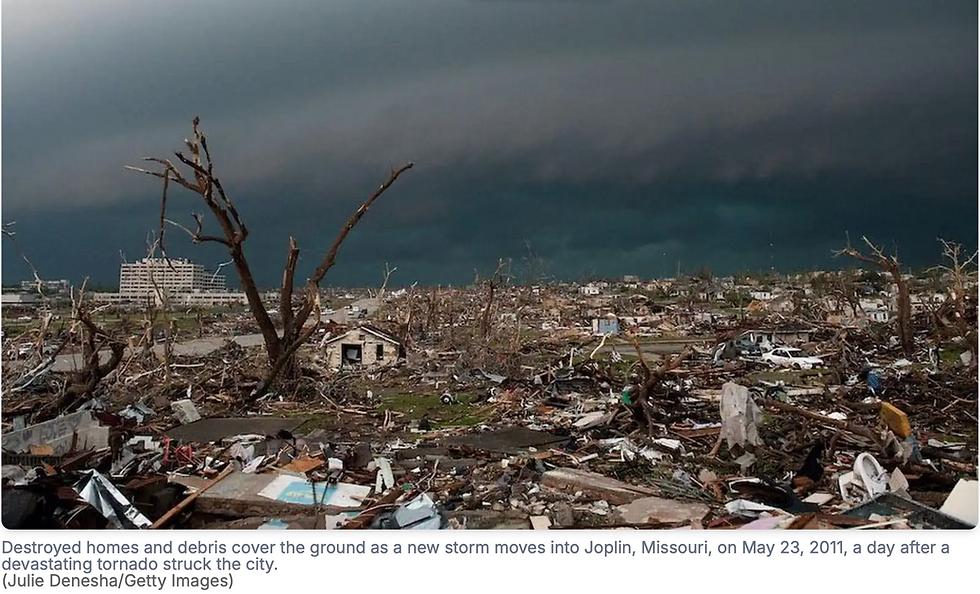
On May 22, 2011 — 15 years ago — an EF-5 tornado with winds exceeding 200 miles per hour tore a mile-wide path through Joplin for 22 miles. 161 people died. More than 1,000 were injured. 7,500 homes were damaged. Approximately 9,200 residents were displaced. 553 businesses were destroyed or severely damaged. Losses approached $3 billion. It remains the costliest single tornado in modern American history.
The tornado did not create Joplin's problems. It revealed them.
As Jay St. Clair, a minister who turned his church into a shelter after the storm and has been doing community service in Joplin ever since, told NPR on this anniversary: "Working people were struggling before the 2011 tornado. After the tornado, we had to see things that we didn't want to see before."
What the tornado also did was destroy one of Joplin's largest affordable housing neighborhoods, and nearly fifteen years later, the city continues to feel its absence. The affordable housing that low-income Joplin residents depended on was wiped out in 38 minutes. It was never adequately replaced. And rising housing costs have made it nearly impossible for the people who need it most to find their way back into stable housing.
460 Homeless Children
Here is the number that should stop every person reading this cold.
According to data compiled by Sharity, the consulting group commissioned by Joplin's city government to study the homelessness crisis: children are the largest group of homeless individuals in Joplin, at 65% of the total homeless population. That is 460 homeless children in a city of 53,930 people.
And it is getting worse, in part because of something that should outrage every resident of this country.
As the Missouri Independent reported in December 2025, Joplin officials spent years hearing reports from residents about people being dropped off from buses at gas stations and truck stops. City officials collected video evidence of out-of-state law enforcement vehicles dropping vulnerable people at Joplin's truck stops. They gathered signed affidavits from people newly arrived in Joplin who said they had been promised a shelter bed or resources at the end of their ride. Medical systems and law enforcement agencies from other states had been quietly offloading their most vulnerable people onto Joplin because Joplin had more shelter beds and social services than surrounding areas.
"People were coming to the City Council meetings and saying, 'I don't know why you guys don't know this, but I'm witnessing busloads of people being dropped off in our town,'" Mayor Keenan Cortez told the Independent. "'Buses are coming in, stopping at gas stations, unloading, and the buses are turning around and going back.'"
Joplin passed an ordinance banning the practice. But the damage to its housing infrastructure and social services budget is ongoing. Meanwhile, Missouri Republicans passed legislation in 2022 making it a crime to sleep on state-owned land, a law modeled on template legislation from a Texas conservative think tank called the Cicero Institute, which is staunchly opposed to the federal Housing First model that has actually been proven to reduce homelessness. The law does not solve homelessness. It criminalizes it.
460 homeless children. A law that makes sleeping outside a crime. An affordable housing shortage rooted in a tornado fifteen years ago. And a state government that has responded by making it harder to be poor, not easier.
The Racial Picture
Joplin is 82.8% white. Its Black population is 3.1% — approximately 1,672 people. Its Hispanic population is 8.9%.
The city has become less racially diverse since the 2020 Census. The diversity index, measuring the probability that two randomly selected people belong to different racial or ethnic groups, fell from 37.9% in 2020 to 33.1% in the most recent estimates.
In a city where 16.9% of people live in poverty, Black residents face a poverty rate of 20.3%. In a city where 14.3% have no health insurance, the disproportionate impact on communities of color is documented nationally and has no reason to be different here.
Only 3.93% of Joplin's residents were born outside the United States, far below the national average of 14%. This is a city with almost no immigrant population, in a state whose Republican senators and representatives have made immigration enforcement a centerpiece of their political identity. Joplin's voters have been persuaded to feel threatened by a demographic that barely exists in their city.
The Votes
In the 2024 general election, Jasper County voted for Donald Trump by a margin of 39,084 to 13,943. That is 74% to 26%. Josh Hawley won the county 38,129 to 13,518, nearly identical. The Republican gubernatorial candidate won 39,119 to 12,785. The Republican House candidate won 38,823 to 12,685.
This is not a swing county. This is a county that has decided, by overwhelming margins, to hand its political future to the Republican Party.
Now look at what that same county voted on, measure by measure, in the same election.
Proposition A
Raise the minimum wage to $15 and guarantee paid sick leave: Jasper County voted NO, 26,781 to 26,050. A margin of 731 votes. Missouri as a whole passed it with 1,693,064 yes to 1,247,658 no. In a county where nearly one in six people lives in poverty and the median household income is $28,000 below the national average, voters rejected a $15 minimum wage and paid sick leave by fewer than 800 votes.
Then the Republican trifecta took over. As the Missouri Independent documented, Governor Mike Kehoe signed HB 567 into law in July 2025, repealing the voter-approved paid sick leave mandate entirely and eliminating the inflation adjustments tied to the minimum wage. The legislature overturned what voters approved, without going back to the voters, because the law had changed a statute rather than the constitution. The Missouri Independent called it a "one-two punch," the courts and the legislature working in tandem to erase what working Missourians had voted for.
Joplin's 731-vote NO on Prop A helped give the Republican majority the political cover to do it.
Amendment 3
Abortion rights and reproductive freedom: Jasper County voted NO, 33,580 to 19,983. Missouri as a whole passed it 51.6% to 48.4%. Jasper County voted against the reproductive rights that the rest of Missouri narrowly secured, rights that directly affect the women who make up 51.7% of Joplin's population and who earn less, are less insured, and face higher poverty rates than men in the same city.
Amendment 7
Ban ranked-choice voting and reaffirm non-citizen voting ban: Jasper County voted YES by a massive margin, 38,805 to 12,583. This is the amendment that banned a voting system that has been shown to reduce partisan extremism and increase voter choice, in a county that is dominated by a single party and where 18% of voters identified as independent in the city's own election results. Jasper County voted to lock itself further into a two-party system that has delivered poverty, poisoned soil, and repealed minimum wages.
Amendment 2
Sports gambling: Jasper County voted NO, 29,386 to 23,739, nearly defeating a measure that would have directed gambling tax revenue to education, in a county where only 26.7% of adults hold a college degree and educational attainment is a persistent economic barrier.
The Betrayal That Has No Bottom
The people of Joplin did not stumble into their circumstances. They were led there, deliberately, by a political movement that has mastered the art of replacing economic grievance with cultural grievance, convincing working people that their enemy is the immigrant who does not exist in their city, the trans person they have never met, the abortion provider 300 miles away, rather than the mine owner who poisoned their groundwater and left, the landlord charging $962 a month on a $52,097 income, or the Republican legislature that repealed their minimum wage vote nine months after they cast it.
As the Missouri Independent's own analysis found after the 2024 election, the fight over Proposition A was never really about whether $15 was the right number. It was about whether voters, specifically working-class voters without college degrees in counties exactly like Jasper, have the right to use the ballot initiative process to improve their own lives. The Republican Party's answer, delivered through the legislature and the courts, was no.
Josh Hawley, who won Jasper County with 38,129 votes, has not introduced legislation to clean up the Oronogo-Duenweg Superfund Site that surrounds his constituents. He has not introduced legislation to expand health insurance access for the 14.3% of Joplin residents who have none. He has not introduced legislation to address the housing crisis that has left 460 children without homes in a single city in his state. He has introduced legislation to restrict immigration, ban TikTok, and perform for cameras at Senate hearings.
Eric Schmitt, who represents the same county, has spent his Senate tenure filing culture war lawsuits and positioning himself for a potential presidential run. Neither senator has made the economic survival of Joplin, Missouri a visible priority.
Why Do They Vote This Way?
This is the question that makes people uncomfortable, and it is the one that most needs to be asked and answered without contempt.
The easy answer is that Joplin voters are ignorant or gullible. That answer is wrong, and it is also politically useless. People who have been called stupid do not change their votes. So let us be honest about what the research actually shows.
They are not simply uninformed.
These are people who lived through a tornado that killed 161 of their neighbors. They have watched their city manage a homelessness crisis being fueled in part by other states dropping their most vulnerable people at Joplin's truck stops. They know their groundwater is contaminated. They know their wages are low and their rents are high. The information about their material conditions is not hidden from them. They live it every day.
What has been hidden from them, or more precisely, what has been deliberately reframed for them, is the answer to the question of who is responsible.
The Democratic Party abandoned them first.
As KRCU public radio reported in 2024, Democrats have not seriously competed in rural Missouri for years. "Rural voters haven't been visited or talked to by Democratic candidates in a while," said the director of rural outreach for a Missouri Democratic campaign. "Democrats want to focus on liberal areas like St. Louis, Kansas City, and Springfield because that's where they think they'll get the most votes." Many rural Missouri races run entirely unopposed, with no Democrat on the ballot at all.
When no one shows up to make the competing argument, the only argument available wins by default. Joplin has been written off by one party and captured by the other, and the party that showed up is the one that showed up with a story, even if the story was false.
The church fills the vacuum.
According to Pew Research Center's analysis of 2024 voting patterns, 81% of white evangelical Protestants voted for Trump in 2024. In southwest Missouri, evangelical and conservative churches are not just religious institutions. They are the primary community infrastructure, the place people find social support, mutual aid, identity, and belonging. When a pastor frames abortion as the defining moral issue of the age, when the church community frames the Democratic Party as anti-Christian and anti-family, when your entire social network is organized around a set of values that Republican politicians have successfully claimed ownership of, the economic cost of voting Republican becomes a price people are willing to pay for community, for moral coherence, and for dignity.
As new polling from the Maine Monitor found in 2025, faith is a primary driver of rural voting behavior. Churches have increasingly highlighted and deepened political divides in rural America, with the result that voting Republican has become inseparable from being a good Christian, a good neighbor, and a real American in communities like Joplin.
The "deep story" is more powerful than the policy reality.
Sociologist Arlie Hochschild spent years embedded in rural Louisiana communities, economically and demographically nearly identical to Joplin, and documented what she called the "deep story" that working-class white Americans tell themselves. In that story, they have been waiting in line for the American Dream their entire lives, playing by the rules, working hard, and they watch as others cut in line ahead of them, aided by a federal government that they increasingly see as working for everyone except them, while coastal elites mock them for their values and call them racists for objecting.
That story is factually wrong in many of its premises. The people cutting in line are not immigrants or welfare recipients. The people actually extracting wealth from Joplin are mining companies that left behind a Superfund site and private equity firms buying up affordable housing. But the deep story is emotionally true to the people living it. And when Trump or Hawley speaks to that story, they are not being rejected; they are being heard in a way that no Democratic politician has managed in a generation.
Institutional betrayal has made them distrust the very people telling them the truth.
As the Missouri Independent has documented extensively, the Republican-controlled legislature has repeatedly overturned ballot measures that Joplin-area voters supported — the minimum wage increase, paid sick leave, abortion rights — without returning to the voters. They are now advancing legislation that would allow as few as 5% of voters in a single district to defeat any citizen-led ballot initiative, effectively ending the direct democracy mechanism that working Missourians have used for over a century to bypass their own legislature.
And yet the voters who watch this happen continue to vote for the people doing it. Why?
Because the institutions telling them this is happening — the media, the universities, the nonprofits, the federal agencies — are the same institutions they have learned not to trust. The federal government rebuilt Joplin after the tornado but never cleaned up the Superfund site. The state government passed a minimum wage and then repealed it. The media covered the tornado and moved on. The pattern of institutional failure is real. The distrust it has generated is rational. And that rational distrust has been expertly weaponized by politicians who use it to inoculate their voters against the very information that would reveal the politicians themselves as the source of the harm.
As the Missouri Independent's own analysis found after the 2024 election, the drop in Democratic support in Ozark plateau communities like those surrounding Joplin was sharpest precisely in the counties most economically distressed, the communities where a $15 minimum wage and paid sick leave would have made the most material difference. The worse the economic conditions, the more dramatically those communities swung toward the party that has made those conditions worse.
That is not stupidity. That is the most successful political con in modern American history.
The people of Joplin are not voting against their interests because they are dumb. They are voting against their interests because they have been abandoned by one party, captured by another, embedded in a religious and cultural ecosystem that frames economic issues as moral threats, cut off from alternative information sources, and systematically taught to distrust the people and institutions trying to show them what is actually happening.
Understanding that is not the same as excusing it. 460 children are still sleeping without shelter tonight. The Superfund site is still leaching lead into the soil. The minimum wage they voted for has been repealed. None of that changes because we understand why.
But contempt for these voters, which has been the default posture of much of the American left for two decades, has not moved a single vote in Joplin's direction. Understanding might.
Sources and Further Reading:
Missouri Independent — Cross-border homeless drop-offs in Joplin | Missouri Independent — Proposition A repeal | KRPS Four States Public Radio — Joplin homelessness crisis | KRPS — Joplin mining history | NPR — Joplin tornado 15th anniversary | U.S. Census Bureau QuickFacts: Joplin | EPA Oronogo-Duenweg Superfund Site | U.S. Fish and Wildlife Service — Tri-State Mining District
All sources linked within this article are from U.S. government records, peer-reviewed research, independent journalism, and official public data. We encourage readers to click every link and verify every claim.


Comments