Missouri’s 2026 Ballot: Vote NO on Amendments 3, 7, and 8

Updated: Aug 30
A voter guide to Missouri’s November 3 constitutional amendments and the measures that may still reach the ballot - Edited 8/19/26
AUG 19, 2026

Missouri voters will decide three statewide constitutional amendments on November 3, 2026. The measures address reproductive freedom, state revenue, and local law-enforcement accountability.
These choices are about more than party labels. They concern bodily autonomy, dependable public services, democratic accountability, and whether Missouri should keep placing detailed policy disputes in a constitution that is difficult to amend. Missouri’s November ballot could also influence strategy and messaging in other states, particularly on reproductive rights, ballot access, and constitutional policymaking.
Missouri voters approved reproductive-freedom protections in 2024. The Legislature has now placed a 2026 measure on the ballot that would repeal those protections while adding restrictions on gender-affirming care for minors. That makes Amendment 3 a significant national test of whether voter-approved abortion protections can withstand a subsequent legislative repeal campaign.
A No vote on Amendment 3 would signal that a voter-approved constitutional right cannot be casually undone through a later ballot measure, especially when repeal is paired with another polarizing policy issue. A Yes vote would offer anti-abortion and anti-trans-rights groups a model for revisiting and potentially rolling back state constitutional protections elsewhere.
Campaigns, advocacy groups, donors, and lawmakers will study Missouri’s resultas they prepare for abortion-related ballot fights already emerging in multiple states in 2026.
This guide covers the constitutional amendments currently associated with Missouri’s November election: Amendments 3, 6, 7, and 8. It also explains why Missouri voters should vote No on Proposition A, the referendum concerning the state’s 2025 congressional map.
Amendment 6 would protect Missouri’s initiative and referendum process by recognizing citizens’ authority to propose, approve, and reject laws through petitions and statewide votes. It would preserve the existing majority-vote and signature requirements, allow courts to review ballot language for clarity and impartiality, and require an 80-percent vote of both legislative chambers before lawmakers could send changes to a voter-approved initiative back to the ballot. The measure would keep final authority with Missouri voters. Vote Yes on Amendment 6.
On August 19, Cole County Circuit Judge Daniel Green ruled that a proposed voter-protection amendment supported by Respect MO Voters could not appear on the November ballot. The campaign is expected to appeal. If the measure is to be restored for the November election, the courts would need to act before September 8, the statutory deadline for court-ordered additions to the ballot. KOMU reported on the ruling and the related litigation.The referendum challenging Missouri’s 2025 congressional map remains in separate litigation. The map divides established communities and links areas with limited geographic and civic connection. It should not be locked into place through a process that weakens community representation. For that reason, this guide recommends voting No on Proposition A.
Amendment 3: Vote No
Amendment 3 would repeal Article I, Section 36, the reproductive-freedom provision Missouri voters approved in 2024. That provision protects abortion access through fetal viability, permits regulation after viability, and preserves an exception when abortion care is necessary to protect a patient’s life or physical health.
The proposed amendment would allow substantially broader abortion restrictions. It would permit abortion only in specified circumstances involving a medical emergency, rape or incest within 12 weeks of gestation, or a fetal anomaly. The amendment would preserve care for ectopic pregnancies and miscarriages. It would also allow regulation of abortion providers and facilities, informed-consent requirements, and parental-consent or judicial-bypass requirements for minors. The Secretary of State’s official ballot-measures pageprovides the certified measure and ballot language.
Amendment 3 would also constitutionally prohibit specified gender-transition procedures for minors, including surgeries, cross-sex hormones, and puberty-blocking drugs, subject to stated medical exceptions.
A No vote keeps Missouri’s 2024 reproductive-freedom protections in force. It preserves the principle that patients, families, and qualified medical professionals, not politicians writing constitutional mandates, should make personal health-care decisions.
Amendment 7: Vote No
Amendment 7 would create the “Show-Me Prosperity Fund,” a permanent public endowment intended to generate enough investment earnings to eliminate state-imposed taxes without spending the fund’s principal. The fund could receive legislative appropriations, gifts, grants, donations, and bequests, while the state treasurer would invest it in exchange-traded funds that track the S&P 500.
The measure would cap annual appropriations from the fund at 3% of its average market value over the preceding five fiscal years. It would prohibit appropriating, pledging, or borrowing against the principal, and it would prevent expenditures until the state treasurer determines that investment earnings could replace state-imposed taxes. The Missouri Senate’s official bill record for SJR 95 describes the proposal’s fund structure and tax-replacement goal.
The amendment includes an emergency provision: if the fund becomes insolvent, suffers a revenue shortfall, or otherwise fails to meet its obligations, the Legislature could raise revenue or enact and increase taxes to preserve state programs. But that contingency does not make the underlying model prudent. Missouri’s schools, Medicaid and other health services, roads, libraries, emergency response, higher education, and public workforce need stable, democratically accountable revenue. Markets can fall precisely when community needs rise.
A No vote rejects embedding a speculative tax-elimination model in the Constitution. Missouri can debate and revise tax policy through ordinary legislation as circumstances change, rather than lock a broad fiscal experiment into the state’s foundational document.
Amendment 8: Vote No
Amendment 8 would amend the Missouri Constitution to require the election of a sheriff every four years in every county except St. Louis City, St. Louis County, and St. Charles County. It would also place specified duties and qualifications for sheriffs in the Constitution, including language requiring sheriffs to commit “felons and traitors” to jail.
Most consequentially, Amendment 8 would provide that an elected sheriff could be removed only through a quo warranto petition brought by the Missouri Attorney General. The Missouri Senate’s official record for SJR 87 describes the four-year election requirement, jurisdictional exceptions, and attorney-general-initiated removal provision.
Much of Missouri’s existing framework governing sheriffs, including their duties and office administration, appears in Chapter 57 of Missouri law. Amendment 8 would instead place detailed office rules and a single removal pathway in the Constitution, making future reform substantially harder.
Sheriffs exercise sweeping authority over policing, detention, county jails, use-of-force practices, and cooperation with other agencies. Missouri should preserve flexible, responsive oversight mechanisms when a sheriff abuses power, neglects duties, or cannot serve. It should not create an additional constitutional barrier that concentrates removal authority in one statewide official.
A No vote keeps sheriff governance primarily in statute, where the Legislature can respond to problems with reforms rather than needing another statewide constitutional amendment to revise constitutional rules.
Missouri Proposition A: Reject the Gerrymandered Map, Vote NO
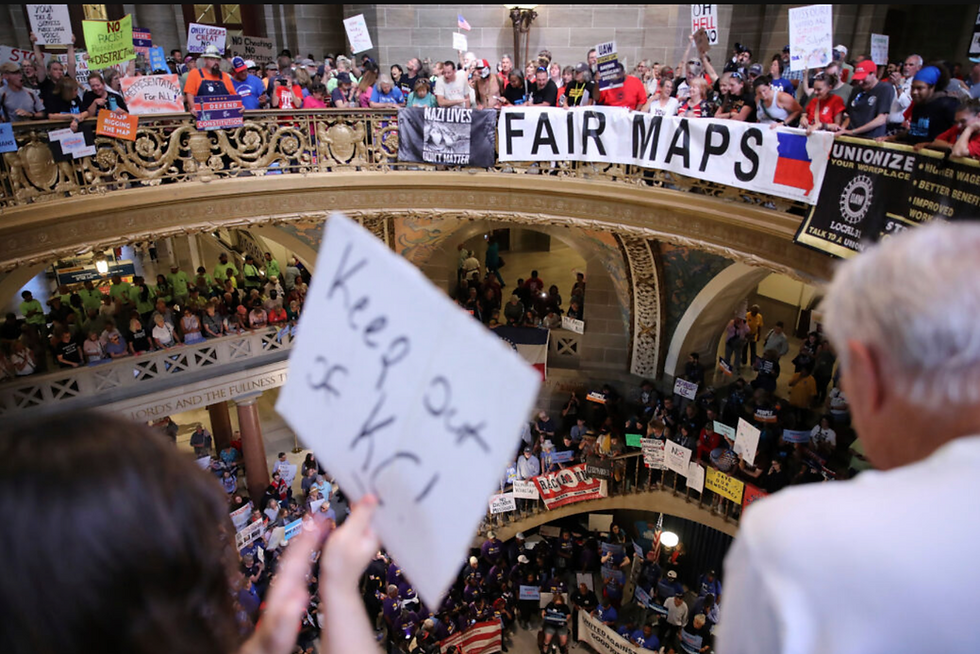
Missouri Proposition A would determine whether the legislature’s new congressional map remains in effect. The map breaks apart established communities by connecting portions of the Kansas City area with rural communities located many miles away. Under the proposed boundaries, Kansas City is divided among multiple congressional districts, while districts stretch across large geographic areas with limited community connection. The map has been challenged in court on the grounds that it violates Missouri’s constitutional requirements that districts be compact, contiguous, as nearly equal in population as possible, and respectful of communities of interest, according to reporting from KCUR and the ACLU of Missouri.
The issue is not simply the appearance of district lines. Congressional districts determine which communities are represented together and which local concerns receive a unified voice in Washington. Splitting cities, counties, school districts, hospital service areas, and other connected communities can make it more difficult for residents to organize around shared needs. A district map should reflect Missouri’s real communities — not serve a political strategy designed to protect incumbents or increase one party’s advantage. Proposition A would preserve a map that opponents say dilutes the influence of urban and rural communities alike by combining them into long, disconnected districts. Missouri deserves fair, compact, contiguous districts that respect communities of interest. Vote No on Proposition A.
Before publication, verify the measure’s exact legal effect using the Missouri Secretary of State’s official ballot materials. Current reporting describes the proposal as a referendum concerning the newly enacted congressional map, so “lock the map into effect” may be more precise than “constitutionalize the map” unless the official text confirms that the map itself would be placed in the Missouri Constitution. NPR and PBS NewsHour have described the measure as part of the effort to challenge Missouri’s newly enacted congressional boundaries.
Amendment 6: Vote YES!
Missouri Amendment 6 would strengthen the initiative and referendum process by recognizing citizens’ authority to propose, approve, and reject laws through petitions and statewide votes. The amendment would preserve Missouri’s existing majority-vote and signature requirements while protecting the initiative-petition process Missourians have used since 1908. That process gives citizens a direct role in lawmaking when elected officials fail to address issues important to the public.sos.mo+1
The amendment would also allow courts to review ballot language and require it to be clear, truthful, and unbiased. It would prevent the General Assembly from simply returning to the ballot an issue that Missouri voters had already approved and enacted. Any legislative effort to alter a voter-approved measure would require approval from 80 percent of both chambers and would then have to return to the people for a final vote. Amendment 6 would keep the final authority with Missouri voters rather than allowing politicians, wealthy donors, or special interests to take control of laws enacted directly by the public. Vote Yes on Amendment 6.
Your ballot checklist
Amendment 3 — Vote No: It would repeal Missouri’s reproductive-freedom provision and authorize broader abortion restrictions.
Amendment 7 — Vote No: It would constitutionalize an investment-fund model intended to replace state taxes, putting essential public-service funding at risk.
Amendment 8 — Vote No: It would entrench sheriff-election and removal rules in the Constitution and limit removal to an Attorney-General-initiated court action.
Congressional-redistricting referendum, Prop A — Vote No: It would reject the Legislature’s 2025 congressional map.
Amendment 6 — Vote Yes It would strengthen the initiative and referendum process by recognizing citizens' authority to propose, approve, and reject laws through petitions and statewide votes.


Comments